

Introduction — a dramatic headline, a complicated reality
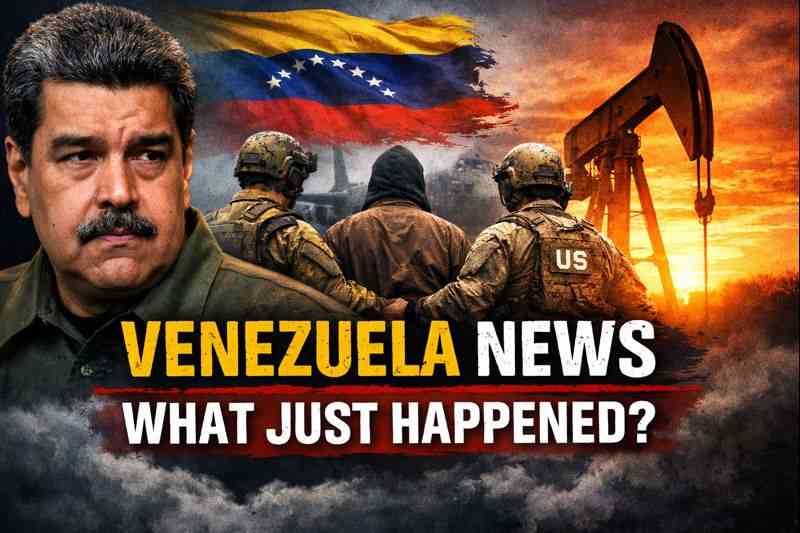
If you opened a news feed in early January 2026, the words “Venezuela news” likely landed like a thunderclap: U.S. forces carried out an operation in Venezuela that resulted in the capture of President Nicolás Maduro and his transfer to the United States, setting off an immediate global and regional crisis. The event has ripple effects across geopolitics, oil markets, migration flows, and humanitarian response — and the story is only beginning to unfold. AP News+1
Below I break the situation down into clear sections — what happened, how the world reacted, the short- and medium-term implications (with a focus on oil and people), and the scenarios to watch next. Wherever possible I link to authoritative reporting and expert analysis so you can dive deeper.
What happened (short version)
- A U.S. military operation penetrated Venezuelan territory and resulted in the capture of President Nicolás Maduro and his wife, who were transported to the U.S. to face federal charges. The operation drew comparisons to past extraordinary operations like the 1989 Noriega case. AP News+1
- Venezuela’s Supreme Court and Vice President Delcy Rodríguez immediately acted to declare continuity measures and insist Maduro remains the country’s president under Venezuelan law — a claim at odds with U.S. statements. The U.N. Security Council scheduled an emergency meeting to assess the act and its implications for international law. Reuters+1
Load-bearing sources: for chronology and verified facts see AP and Reuters; for a detailed operational narrative see Al Jazeera. AP News+2Reuters+2
Comparison: Venezuela before vs after the operation
| Dimension | Before (late 2025) | After (early Jan 2026) |
|---|---|---|
| Political control | Maduro’s government (contested), domestic opposition fragmented | Maduro detained; Supreme Court names Delcy Rodríguez as interim; U.S. claims custody — competing claims of legitimacy. Reuters+1 |
| International response | Sanctions, diplomatic isolation from some countries, support from allies (Russia, Cuba, Iran) | Immediate uproar: mixed global reactions, UN emergency meeting, sharp regional divisions. Reuters+1 |
| Oil sector | Under sanctions and sanctions-evasion networks; limited production vs potential reserves | U.S. signals intent to “run” Venezuela and tap oil reserves; markets speculating about supply shocks. U.S. Department of the Treasury+1 |
| Humanitarian/migration | Millions displaced regionally; continuing humanitarian needs | Heightened instability may spike displacement and disrupt aid channels. iom.int+1 |
Key insights and analysis
1) The operation rewrites geopolitical assumptions — but not overnight
A unilateral strike that results in the removal (or detention) of a sitting head of state is rare and raises profound questions about sovereignty and precedent. International institutions — notably the UN — have already signaled alarm, and many countries have condemned unilateral military action, while others welcomed the outcome. Expect immediate diplomatic fallout, including potential tit-for-tat sanctions, shifting alliances, and heightened regional tensions. Reuters+1
2) Oil markets will be nervously watchful — potential upside, but many caveats
Venezuela sits on one of the world’s largest proven oil reserves. Market commentators and analysts are quickly assessing the possibility that U.S. control or influence could unlock Venezuelan output — a move that could ease global oil tightness if sustained. But turning geological reserves into barrels requires functioning companies, investment, logistics, and political stability. Any increase in supply would take months to materialize and could be constrained by sanctions, lack of infrastructure, and political resistance. In short: big potential, long timelines. Forbes+1
Quick take: Expect short-term volatility (prices and traders react to headlines), but real supply shifts would be gradual and politically fraught.
3) Humanitarian and migration consequences will likely worsen
Venezuela’s displacement crisis has already been one of the largest in the Western Hemisphere, with millions living abroad and many more dependent on fragile local systems. A sudden power vacuum, armed clashes, or disruptions to essential services (electricity, food distribution, health) risk triggering new waves of migration into neighboring countries already strained by inflows. Regional institutions and agencies (IOM, UNHCR, local NGOs) will need immediate access and funding to respond. iom.int+1
4) Sanctions, oil traders, and legal complexity
Even before the operation, the U.S. Treasury targeted intermediaries believed to be helping the Maduro government evade sanctions. Post-operation policy choices — whether to fully re-open Venezuelan oil to certain buyers or to control flows tightly — will determine who benefits economically and politically. Any sudden legal or administrative moves to transfer control of assets will be contested in courts and on the ground. U.S. Department of the Treasury
5) A fragile transition — beware of multiple “rocky” scenarios
Several scenarios are plausible:
- Managed transition: International oversight, quick stabilizing steps, and a path to elections (ambitious).
- Factional instability: Military splintering, armed clashes, or localized breakdowns that complicate governance.
- Prolonged standoff: Parallel claims to legitimacy (inside/outside), economic disruption, and international legal battles.
None are guaranteed; local actors (military leaders, state institutions, civic groups) will shape outcomes more than outside powers. Expert institutions (Atlantic Council, Chatham House) emphasize the uncertainty and the danger of over-optimistic forecasts. Atlantic Council+1
Quick data snapshot (table)
| Indicator | 2024–25 Baseline | Immediate signals |
|---|---|---|
| Venezuelan migrants in region | ~6.8 million+ (est.) | Continued pressure; risk of spikes. Humanitarian Action+1 |
| Oil reserves | Among largest globally | Policy—not geology—now the main constraint. Forbes |
| International response | Mixed | UN emergency meeting; divided regional responses. Reuters+1 |
What to watch next (short horizon)
- Domestic security incidents — protests, clashes, or uprisings that could reshape control on the ground.
- UN and OAS outcomes — legal and diplomatic steps that may constrain or legitimize actors. Reuters
- U.S. policy details — will Washington move to administer Venezuelan resources, or will it set up international trusteeship arrangements? Watch Treasury and State Department briefings. U.S. Department of the Treasury
- Oil-market signals — producers’ statements, tanker movements, and trading sanctions enforcement. Forbes+1
- Humanitarian corridors and funding — whether aid agencies get safe access and increased resources. iom.int
A few practical takeaways for readers
- If you follow markets: expect short-term swings; don’t assume immediate, massive Venezuelan output. Forbes
- If you follow geopolitics: this is a precedent-setting episode; watch how countries respond at the UN and in regional bodies. Reuters
- If you care about people: support vetted humanitarian organizations working with Venezuelan migrants and communities — crises tend to hit the most vulnerable first. iom.int
Conclusion — why “venezuela news” matters beyond the headlines
This episode is a rare intersection of domestic politics, international law, great-power rivalry, and energy security. The short-term drama dominates headlines, but the longer story will be written by messy governance, legal fights, and human resilience. Whether the outcome stabilizes the country or plunges it into further turmoil will depend on a complex mix of local choices and international constraints.
If you want to stay informed, follow a mix of: investigative reporting (AP, Reuters, Al Jazeera), policy analysis (Atlantic Council, Chatham House), and humanitarian updates (IOM, UNHCR). I’ve linked key sources above so you can dig deeper.




Pingback: Affordable Screen Printing Accessories | Low-Investment - Blexo- Growup